

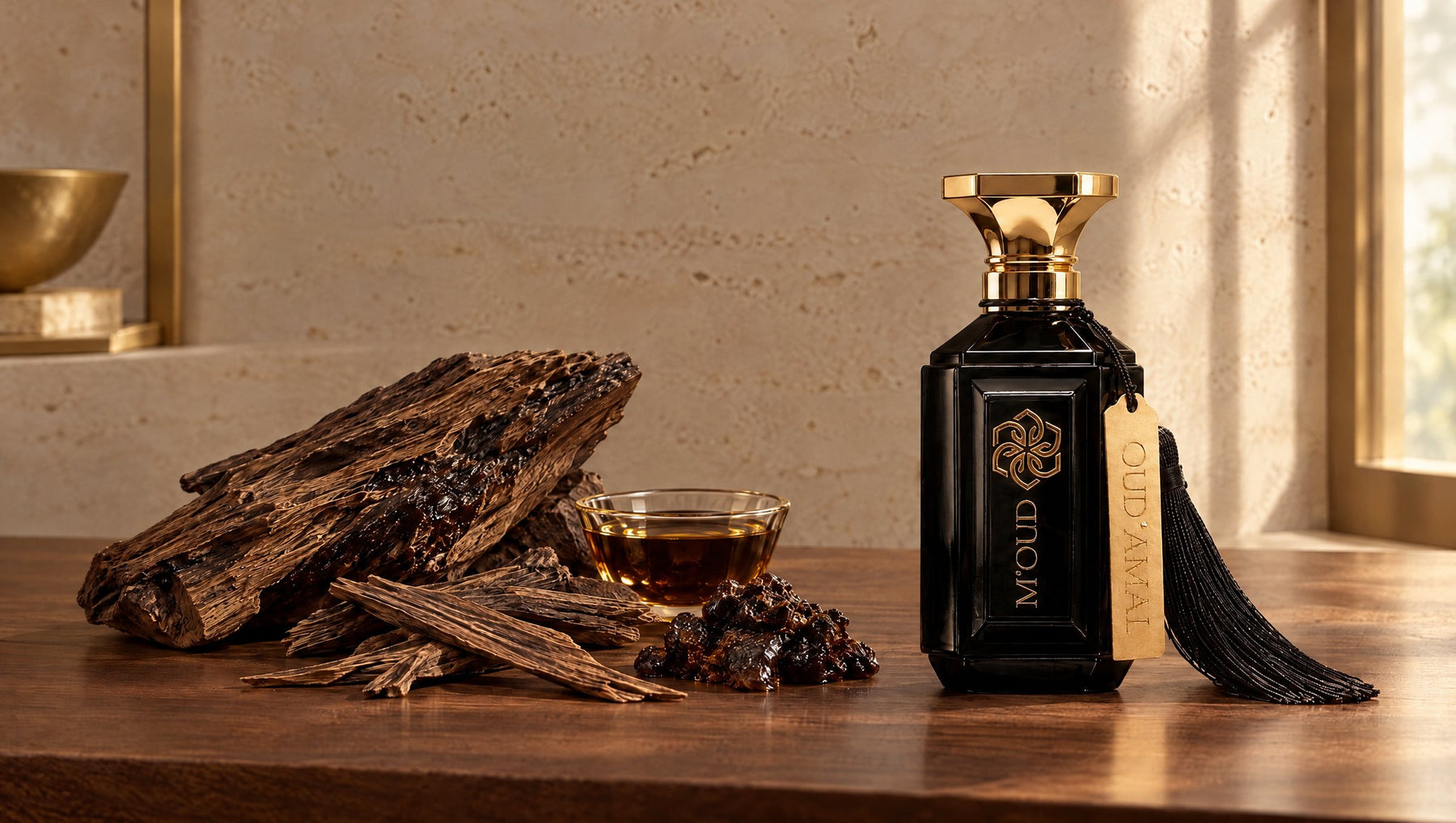
Real oud or synthetic — how to tell
What tells natural oud apart, and what does not.
An oud fragrance can be built on natural agarwood or on an accord of aroma molecules. Both are legitimate. Here is what the difference actually is, and how it behaves on skin.
What is synthetic oud?
Synthetic oud is an accord: a blend of aroma molecules arranged to read as agarwood. No tree is involved. It is stable, repeatable, affordable, and it does not vary between batches. Those are real advantages.
What it cannot do is behave like wood. An accord holds its shape. Natural agarwood shifts: it opens differently on one person than on another, and it moves across the hours.
Why is real oud expensive?
Agarwood is not a wood a tree grows. It is what an Aquilaria tree produces when it is wounded and microorganisms enter: resin laid down as a defence, over decades. In the wild, only a small share of trees forms this resin. The genus is listed under CITES Appendix II, so every legal shipment carries paperwork.
The price is a tree, twenty years, an injury and a permit.
How do you tell the difference on skin?
Not by the opening. In the first ten minutes a good accord can be indistinguishable, sometimes louder. The difference shows in hours three to six.
An accord stays where it started, then fades in one piece. Natural agarwood loses its top and keeps going: smokier, drier, closer to the skin. Two people wearing the same natural oud will not smell the same by evening.
Where the material stops mattering
Natural agarwood alone guarantees nothing. What a fragrance does on skin is decided after the raw material arrives: in the composition, in how long it rests, in where the filtration line is drawn.
During maturation, alcohols react with natural acids to form esters, molecules that smell rounder and softer. Oud Amal rests six months before filling.
What M'OUD uses
Natural oud oil from Thailand in all four extraits, the same material beneath each one, composed and filled in Switzerland at 30 to 35 percent.
It is not a claim about being better. It is a decision about what the house is for.
Questions
How can I tell if oud is real?
Ask whether the oud source and origin are named, and wear it for several hours: natural oud keeps changing after hour three, an accord tends to stay the same.
Is synthetic oud bad?
No. Synthetic oud is stable, consistent and affordable. It behaves differently over time than natural agarwood.
Does M'OUD use real oud?
Yes. All four M'OUD extraits contain natural oud oil from Thailand.
None of this settles on paper. Three extraits of 2 ml each, and the full CHF 40 comes off your first bottle.
Discovery SetWhat is oud?